Friday, January 5, 2024

Reading Thoreau project

Aulus Persius Flaccus (1840) (Online) (another version) X

The Service (1840) (I find this one in the book of essays.) Librivox x Another difficult essay.

A Walk to Wachusett (1842) x YouTube

Paradise (to be) Regained (1843)

The Landlord (1843)

Sir Walter Raleigh (1844)

Herald of Freedom (1844)

Wendell Phillips Before the Concord Lyceum (1845)

Reform and the Reformers (1846–48)

Thomas Carlyle and His Works (1847)

A Week on the Concord and Merrimack Rivers (1849)

Resistance to Civil Government, or Civil Disobedience, or On the Duty of Civil Disobedience (1849)

An Excursion to Canada (1853)

Slavery in Massachusetts (1854)

Walden (1854)

A Plea for Captain John Brown (1859) (Online) (Wikipedia)

Remarks After the Hanging of John Brown (1859)

The Last Days of John Brown (1860)

The Succession of Forest Trees (1860) (Online)

Walking (1862)

Autumnal Tints (1862) (Last published work while alive) (online Atlantic doesn't hold the copyright so I don't think it should be behind a paywall)

Wild Apples: The History of the Apple Tree (1862)

Died May 6th 1862

The Fall of the Leaf (1863)

Excursions (1863)

Life Without Principle (1863)

Night and Moonlight (1863)

The Highland Light (1864)

The Maine Woods (1864) (T couldn't figure out an ending, but edited to the end)

Cape Cod (1865)

Letters to Various Persons (1865)

A Yankee in Canada, with Anti-Slavery and Reform Papers (1866)

Early Spring in Massachusetts (1881)

Summer (1884)

Winter (1888)

Autumn (1892)

Miscellanies (1894)

Familiar Letters of Henry David Thoreau (1894)

Poems of Nature (1895)

Some Unpublished Letters of Henry D. and Sophia E. Thoreau (1898)

The First and Last Journeys of Thoreau (1905)

Journal of Henry David Thoreau (1906)

The Correspondence of Henry David Thoreau edited by Walter Harding and Carl Bode (Washington Square: New York University Press, 1958)

I Was Made Erect and Lone (Online, two) X (Analyzed by Steven Ward)

The Bluebird Carries the Sky on His Back (Stanyan, 1970)

The Dispersion of Seeds published as Faith in a Seed (Island Press, 1993)

The Indian Notebooks (1847–1861) selections by Richard F. Fleck

Wild Fruits


X=Read or listened to read. 

This was from Wikipedia. I'm going to finish the Walls biography and read more books about Thoreau, but I'm going to also try and read his original works to the best of my ability.

I thought about trying to determine how many pages each thing was, and then spreading it over a year, but I know I'm not good at sticking to schedules, I'm better at going at my own pace.

Some of these things will be harder to find than others. For instance the first one isn't in my essays electronic book. So I included the link where I found it.


Other things to consume, to be considered:

Walden: The Ballad of Thoreau--Michael Johnathon's theatrical play. YouTube


Thursday, January 4, 2024

Today's notes from reading Thoreau biography


The Farmers Club in 1850's Concord, thought retention of people through education was the way to keep people from leaving for the city or out west. Thoreau wasn't part of the club, but they asked him where to get wildflowers when they wanted to decorate the town and how to rehabilitate forests who were damaged. I was reading in the Times that American cities are losing people these days and I think the city needs to do some to keep people in the city. They have planted a lot of trees, which delights me. 

They noticed that pine forest changed to Oak, squirrels burying acorns had an oak tree just waiting for a pine tree to fall down. The subject now is called plant succession, another subject Thoreau was a pioneer of. 

Speaking of environmentalism, I think there is a lifestyle paradox. If you really like nature, you spread out into the sprawling suburbs instead of living in the city, which might be the most environmental thing you could do, using public transport, and living in buildings instead of heating a house that just bleeds heat. So if you love nature, come live in NYC!

It does bring up the point that some subjects aren't in books, and you have to go it alone. People without education will always point this out, but people who read books know it too. 

The amazing knowledge that Thoreau had was that he could even say what day of the month it was by which flowers were blooming.

In 1954 he had this photo taken for 16 cents, according to Walls. I think now I might have gotten that wrong, I was misreading Walls. The national portrait gallery puts it at 1956 and for 50 cents, perhaps the case that came with it:


Maybe it was 1856 because what comes next is the capturing of the pigs, which is August 8th 185.

Wednesday, January 3, 2024

First sketch of Thoreau


Thoreau had this above sketch done of him by Samuel Worcester Rowse soon after publishing Walden. At the same time he also published Slavery In Massachusetts, disgruntled a slave was taken back after he had escaped. He was suddenly famous. There were good reviews.

He got a fan letter from Adrien Roquette who would go and live among the Choctaw Indians. 

He went as far as Philadelphia, and back in New York went to the opera with Greely and saw I Puritani by Bellini. He wrote What Shall It Profit, which along with Walking were published after his death and were his two main lectures for his lecture tours. With a few cool receptions, Thoreau lamented his travels and missing being out in nature at home, he canceled his tour out west. He was not going to be a lecturer like Emerson. With a few more lectures, he concluded his lecturing tour, off the heat of Walden, for a few years. 

He was well received in Nantucket, and he connected with a fair amount of people during this time, including a biographer Franklin Benjamin Sanborn who moved to Concord to teach school, sponsored by Emerson. The school teacher took meals at the Thoreau's and lived in Channing's top floor. 

Winter was for skating on the Concord River. The frenzied winter led to a period of illness for Thoreau, perhaps a flare up of tuberculosis. He grew a neck beard, called Galway Whiskers, to keep his throat warm.


Thoreau is the perfect person to study in this age of trying to get attention.

Tuesday, January 2, 2024

Waning moon


It’s 29° and there’s a 64% waning moon. No Henry today. Tomorrow is the day the earth will be closest to the sun.

Monday, January 1, 2024

Thoreau and the Irish refugees

"The Irish, too, continued to intrigue Thoreau, as growing numbers of refugees settled in Concord. In 1850, when three generations of the Riordan family moved into a shanty near the Deep Cut, at first he was horrified by their dirt-floor poverty. But as he came to know them, he wondered if the Irish weren't realizing his ideals better than he was, living independent lives close to the land without being seduced by Yankee markers of success. He especially admired young Johnny Riordan, leaping "lively as a cricket" from snowbank to snowbank on his way to school while the worthies of Concord waddled past encased in furs. In January 1852, when he saw Johnny with no jacket and snow melting on his bare toes, Henry rushed to tell Cynthia, who set the Charitable Society to sewing. A week later Henry brought Johnny's new coat to the shanty, which he found "warmed by the simple social relations of the Irish... What if there is less fire on the hearth, if there is more in the heart." There he learned that Johnny's uncle had moved to town and took the Irish newspaper, the Flag of Our Union; and it was "musical news" to hear that Johnny, one of the school's best students, "does not love to be kept at home from school in deep snows."" (p. 328 Walls)

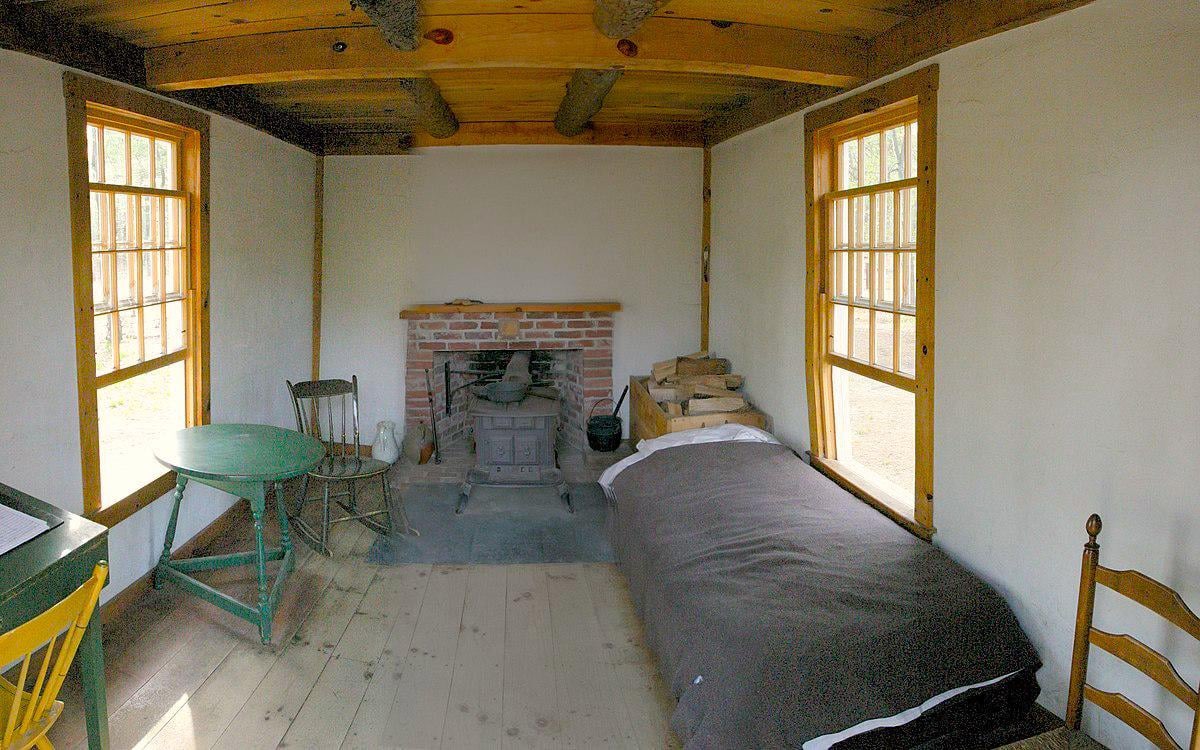
Replica of Walden home


He bought wood from the Irish shanties as they moved on to work on the railroad. He seemed to love all kinds, the Native Americans, the escaped slaves. He wrote about helping one escaped slave, in his journal, which would have been incriminating evidence if he journal was ever seized for a court case.

There is something large in spirit, in his insistence to walk, to remain mostly local, to oppose injustice, to wish to be free.

When he went to Cape Cod the first time there was a shipwreck, a hunger ship of starving Irish people whos boat smashed and most of them died. It was a horrible spectacle and wasn't exactly what he expected. A few years later visiting the exact same spot, everything was gone. He would soon go to Fire Island to see if he could find anything of Margaret Fuller, and he only came back with a button. Her book on Rome was lost, her future as a suffragette, and her baby and husband, all died as the bound foundered on a sandbar 300 feet from the shore.

Thoreau was outraged when an employer took the $4 prize from a laborer who won a spading contest. He raised $50 to get Michael Flannery's wife and children to America from Ireland. They got there safely and stayed with the Thoreaus until they were settled. And he wasn't rich like Emmerson who was quite generous with Thoreau. 

Henry

Henry was there in the water. I cleared the reeds so he could climb on land but he froze while I sat there.


Walking

 Walking by Henry David Thoreau. It starts...

"I WISH to speak a word for Nature, for absolute freedom and wildness, as contrasted with a freedom and culture merely civil, - to regard man as an inhabitant, or a part and. parcel of Nature, rather than a member of society. I wish to make an extreme statement, if so I may make an emphatic one, for there are enough champions of civilization: the minister, and the school-committee, and everyone of you will take care of that.

I have met with but one or two persons in the course of my life who understood the art of Walking, that is, of taking walks,- who had a genius, so to speak, for sauntering: which word is beautifully derived "from idle people who roved about the country, in the Middle Ages, and asked charity, under pretence of' going a la Sainte Terre," to the Holy Land, till the children exclaimed, " There goes a Sainte-Terrer," a Saunterer, - a HolyLander. They who never go to the Holy Land in their walks, as they pretend, are indeed mere idlers and vagabonds; but they who do go there are saunterers in the good sense, such as I mean. Some, however, would derive the word from sans terre, without land or a home, which, therefore, in the good sense, will mean, having no particular home, but equally at home everywhere. For this is the secret of successful sauntering. He who sits still in a house all the time may be the greatest vagrant of all; but the saunterer, in the good sense, is no more vagrant than the meandering river, which is all the while sedulously seeking the shortest course to the sea. But I prefer the first, which, indeed, is the most probable derivation. For every walk is a sort of crusade, preached by some Peter the Hermit in us, to go forth and. reconquer this Holy Land from the hands of the Infidels.

It is true, we are but faint-hearted crusaders, even the walkers, nowadays, who undertake no persevering, never-ending enterprises. Our expeditions are but tours; and come round again at evening to the old hearth-side from which we set out. Half the walle is but retracing our steps. We should go forth on the shortest walk, perchance, in the spirit of undying adventure, never to return, - prepared to send back our embalmed hearts only as relics to our desolate kingdoms. If you are ready to leave father and mother, and brother and sister, and wife and child and friends, and never see them again, - if you have paid your debts, and made your will, and settled all your affairs, and are a free man, then you are ready for a walk."

(spelling corrected and updated)


Librivox audio of essay on YouTube.